If you are looking for games for rainy days, the kind you can sink into while the window streams and the kettle ticks, Ninefold Hidden Object Mystery was made with weather in mind. It is a story-driven mystery for adults, with no timers, no energy and no purchases, and its storms do something quietly clever with light. Here is how to settle in with it on a wet autumn afternoon.
Why Ninefold suits a wet afternoon
Ninefold asks for nothing but your attention. Nothing counts down while you search, there is no energy bar to wait for and there is nothing to buy. An afternoon with it can be as long or as short as the rain.
It is also fully offline. The app has no network code at all, so a patchy connection on a stormy day makes no difference. There are three save slots, each one autosaves, and Continue on the title screen picks up your most recently played unfinished game. That makes it easy to put down for a cup of tea and come back to later.
The mystery spans nine rooms, with eight who stayed. This guide sticks to the opening chapters, the Gates, the Entrance Hall and the Nursery, so there are no spoilers beyond them.
A house that sounds like weather
There is no music anywhere in Ninefold, and that is deliberate. What you hear instead is room tone, rain, clocks and narration. Put headphones on during a grey afternoon and the weather outside and the weather in the game start to blur together.
The narration is a single voice throughout, generated with a local text-to-speech model. Subtitles are always on, so you never miss a line if the rain is loud or you are playing quietly. Every sound effect and font is credited on the in-game Credits screen.
Lightning-lit rooms: why each scene is painted twice
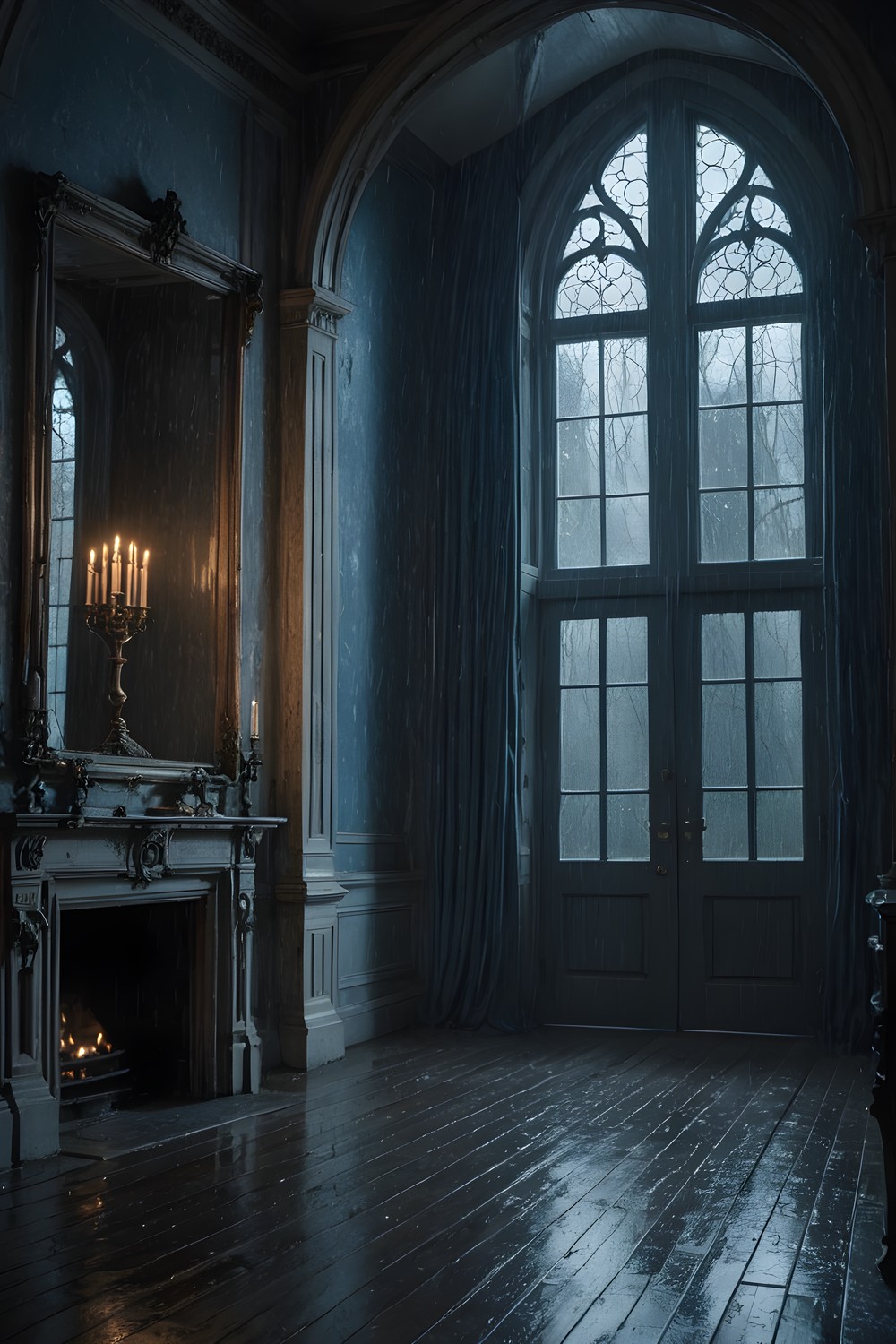
Ninefold's storms are where its rainy-day character shows most. Each room exists as two paintings, one in normal light and one as it looks in a lightning flash. During a storm the game swaps between them instead of just brightening the picture, so a flash shows you the room in a genuinely different light.
Before you start searching, it is worth pausing to watch a few flashes. Seeing the room both ways helps you learn the space, and a corner you had passed over in the everyday light can catch your eye in the flash.
The scenes are large paintings, 2688 × 1536, and they are always shown whole. On a 16:9 phone you will see dark margins at the sides rather than a cropped room, so nothing can hide off-screen. You can zoom in up to 3×, and panning stops at the painting's edges, so you never lose your place. The art, like the narration, is AI-assisted.
Your first rooms: the Gates, the Entrance Hall and the Nursery
Each room hides sixteen objects, but the list only ever shows six names at a time. It refills in a fixed order as you find them, so the search unfolds steadily rather than all at once.
Tapping something that is not on the list does nothing at all. There is no penalty for a wrong tap, so you can tap whatever catches your eye.
If you want a gentle start in the Nursery, the art pipeline scored every hidden object for colour contrast, camouflage and on-screen size, and five of the Nursery's objects came out as easy: the bear, the winding key, the drum, the train and the marble. Three Nursery finds also go into your inventory: the winding key, a candle stub and a broken key whose shaft has snapped clean off. Hold on to that last one.
You use items by dragging them onto the scene, and the drop has to land inside the right spot. Taps get a little leeway, but drops get none, so place them carefully. Once you have found all sixteen objects in the Nursery, look around again: chalk writing appears that was not there before.
A real deduction board
Ninefold's deduction board is a real board, not a checklist. You link clues together with thread, and a wrong connection does no harm. The thread just falls with a slack-string sound and you try again.
You can move the cards around however you like, and the game saves your layout. On a slow, wet day, arranging the board in an order that makes sense to you is part of the pleasure.
Making it comfortable
If you get stuck, the hint button never leaves you stranded. It works through a priority list: an open puzzle first, then an object in the room you are in (easiest first), then a hotspot, then a board thread, then an item combination, and finally the way to the nearest room with work left. Hints recharge on a timer, shown as a ring filling around the button. The ring takes 60 seconds on Casual and 180 seconds on Expert.
The accessibility options change how searching feels. Highlight interactables draws a frame around every listed object, and Object silhouettes puts each object's shape beside its name in the list. Reduce motion applies everywhere: crossfades drop to zero, the found-object animation shortens from 0. 9 to 0. 35 seconds and the lamp flicker stops.
Frequently asked questions
Can I play Ninefold without an internet connection?
Yes. The game is fully offline and the app has no network code at all, so it works the same with or without a connection.
Is there a time limit or anything to buy?
No. Ninefold has no timers on your search, no energy system and no purchases. The only thing on a timer is the hint button, which recharges in 60 seconds on Casual and 180 seconds on Expert.
How are the art and narration made?
Both are AI-assisted. The narration is one voice throughout, generated with a local text-to-speech model, and subtitles are always on. Every sound effect and font is credited on the in-game Credits screen.
Put the kettle on, dim the lights and let the rain and the clocks keep you company. Ninefold is live on Google Play, and a wet afternoon is a good time to open its gates.
More from AstroForged